
Robis Elections
AskED ePollbook
Make / Model: Robis AskED ePollbook
Equipment Type: Electronic Poll Book
Overview
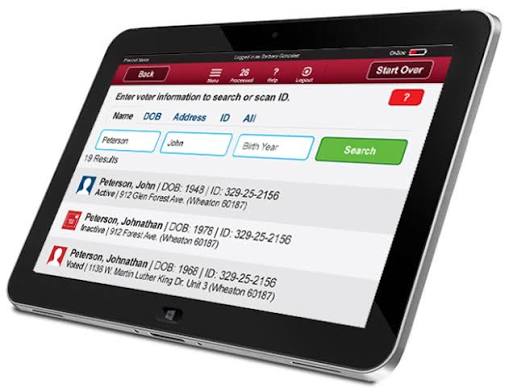
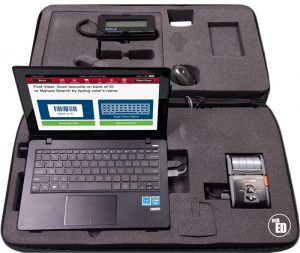
The AskED ePollbook is a standalone electronic poll book system developed by Robis Elections that operates on commercial off-the-shelf (COTS) laptops or tablets running the Windows 10 Pro operating system. To secure the precinct environment, the devices are hardened into a locked-down “kiosk mode,” strictly restricting poll worker access to the proprietary AskED application interface. The software’s defining operational characteristic is its patent-pending AskED Election Decision Support™ framework, which integrates customized local and state statutory regulations directly into the localized user interface to eliminate procedural guesswork.
Architecturally, the system is designed to maintain full functionality in completely disconnected environments by housing a fully operational SQL database client with a localized, encrypted copy of the complete jurisdiction roster directly on the device. For broader deployment, the precinct units interface with the web-based AskED Command Center and its centralized AskED Help Desk management platform. This administrative backend allows central office personnel to monitor real-time precinct metrics, log and route support calls, and instantly track hardware health or specific procedural alerts reported by election officers. Deployed in pre-wired, lightweight “all-in-one” bags, individual devices can be networked together via local peer-to-peer LAN configurations (hardwired or 256-bit WPA2 encrypted Wi-Fi) to sync check-ins within a single polling place, or utilize cellular VPN connections to broadcast real-time data back to central administration.
Processing Voters
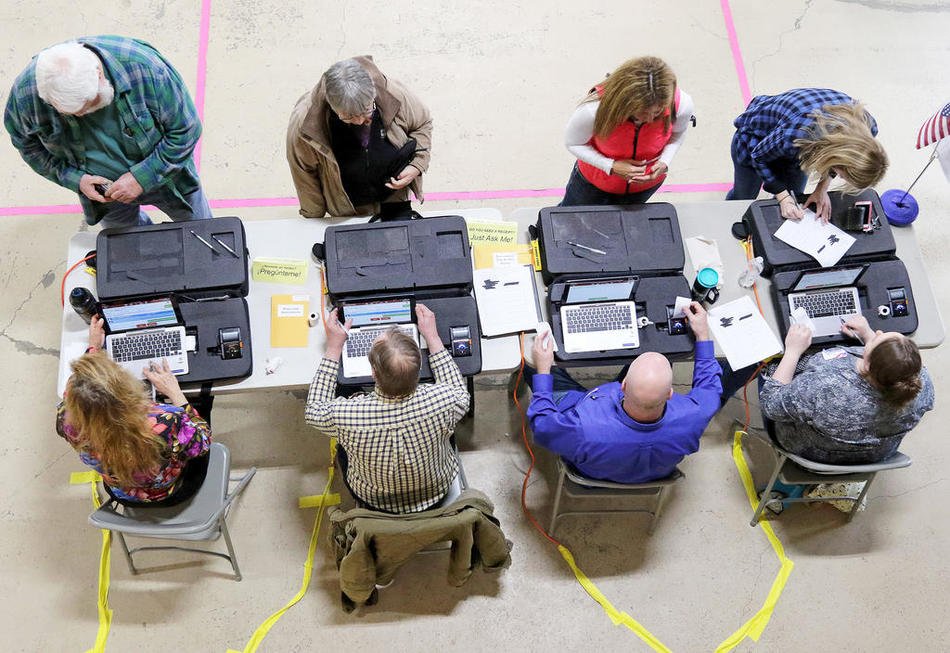
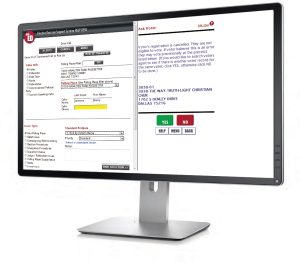
Voter check-in is initiated when an election officer looks up a record by manually entering identifying credentials or executing a barcode scan of a state-issued photo ID using either an integrated camera or a peripheral Zebra scanning gun. The software cross-references the localized data cache to instantly render the voter’s registration status, ballot style, and active voting history. If any administrative flags are detected—such as an unreturned absentee ballot or a jurisdictional boundary change—the Election Decision Support™ system prompts the worker with an automated sequence of simple “yes” or “no” questions to guide them through the precise statutory reconciliation process.
Once eligibility is established, the voter’s identity is authenticated via direct on-screen touchscreen signature capture or an attached external Topaz signature pad. Upon confirming the check-in, the system logs the transaction to the internal database and triggers compatible COTS peripherals to finalize the process.
In jurisdictions leveraging vote centers or early voting sites, the software activates its fully integrated AskED Ballot on Demand module. Rather than requiring pre-printed ballot inventories, the ePollbook utilizes Adobe PDF integration to send an automated over-the-counter command to a local laser printer, instantly producing the voter’s precise, precinct-specific ballot style on the spot. Alternatively, the system can print an authentication barcode via an attached DYMO printer or utilize ExpressPass software to encode a voter access token for compatible ballot-marking devices.
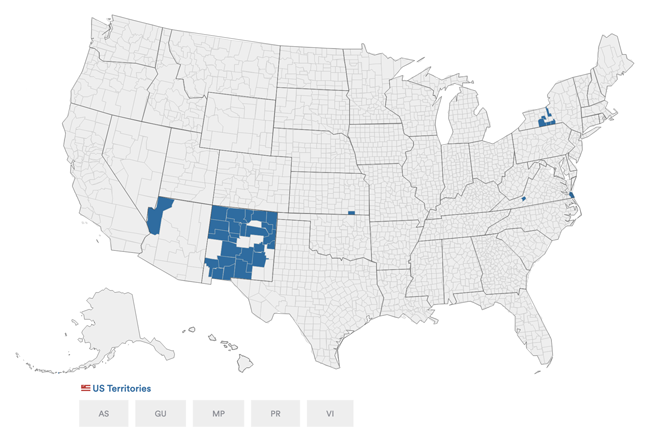
Robis AskED ePollbook usage in November 2026 (click map for details)
Resources
Robis AskED® ePollbook with On-Demand Ballot Printing: Use Procedures Guide for California (2018)
Electronic Poll Book System Source Code Review Test Report for California (2018)
Response to Request for Proposals from Georgia (2018)
State of Colorado, Department of State ePollbook and Ballot On-Demand (2013)
Security Concerns
Networking and Restrictions
The AskED ePollbook software can operate without an internet connection or connection to other ePollbooks. The ePollbook hardware can be hardwired or wireless. Connections are IP-restricted and secured with SSL TLS 1.2, and can be set up with a hardware VPN. When the ePollbook is set up to run wirelessly, all connections are 256bit WPA2 and a 63+ character password is required.
When connected, the ePollbooks synchronize their data with a jurisdiction’s central database in near-real-time to update information from the jurisdiction’s voter registration system, and vice versa. Robis Elections will provide firewall-level IP filtering to be used with the Command Center and Help Desk.
Software and Hardware Limitations
Robis limits functionality so that poll workers may only access the AskED software application on the computer. To access the AskED application, the poll worker must first enter the POLLWORKER Windows password and then enter their username and password for the AskED application. The ePollbook application can also be configured to require users from two political parties to enter separate passwords before access is granted.
A jurisdiction can also choose to have their AskED ePollbook applications automatically “self-destruct” and delete voter data a certain number of hours after polling places close or after Election Day.
Manufacturer Profile

Robis Elections was established in 1991 by David Davoust. The company is headquartered in the Chicago area, with a Regional Election Support Center in Albuquerque, NM. The ED in its systems line stands for Election Decision. Robis Elections systems are intended to allow for flexibility, including transitioning from polling places to vote centers.